1
A built-in battery
Most rechargeable hearing aids use a lithium-ion battery sealed inside the hearing aid. There is no battery door to open and no small battery for you to handle.

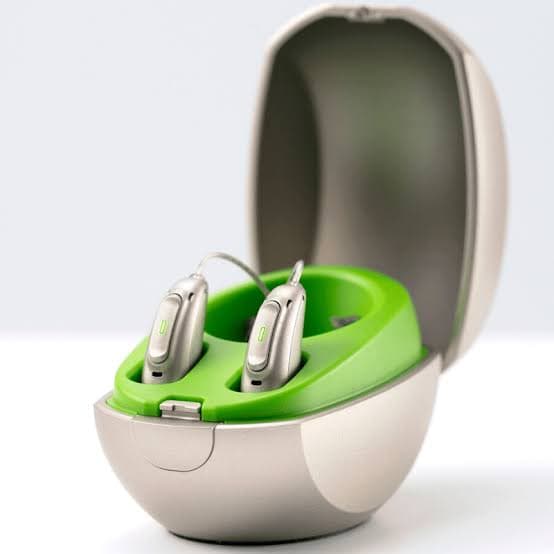
A rechargeable hearing aid has its battery built in. Instead of changing tiny batteries every few days, you place the hearing aids in a charger at night and wear them again in the morning.
Many rechargeable hearing aids also connect to your phone by Bluetooth, so you can hear calls, music and videos through them. This page explains how both features work, how rechargeable batteries compare with disposable ones, and who they may suit.
Jump straight to the part you want to read first.
A rechargeable hearing aid works in the same way as any other hearing aid. The difference is where its power comes from.
Most rechargeable hearing aids use a lithium-ion battery sealed inside the hearing aid. There is no battery door to open and no small battery for you to handle.
When you take the hearing aids off, you place them in a charger. Small metal contacts or a magnetic connection charge the battery. Some charging cases have their own battery, so you can charge away from a power point.
Many rechargeable hearing aids are designed to last through a full day of normal use on one charge. Long streaming sessions, long wearing hours and an older battery can shorten this.
Like a phone battery, a hearing aid battery slowly holds less charge as it ages. If your hearing aid no longer lasts the day, the clinic can check it and advise on servicing.
Both kinds of battery work well when they suit your routine. This table shows the main differences.
| Point to consider | Rechargeable | Disposable |
|---|---|---|
| Daily routine | Charge overnight in the case, like a phone. | Change the battery every few days to a couple of weeks, depending on battery size and use. |
| Handling | No small batteries to handle. | Needs steady fingers and good eyesight to change small batteries. |
| If power runs low | Put the hearing aids back in the charger, or carry a charging case on long days. | Swap in a spare battery. Carry a few with you. |
| Travel | Take the charger with you, or use a case with its own battery. | Spare batteries are small and easy to carry. |
| Styles | Most common in BTE and RIC hearing aids, and in some ITE models. | Available in almost every style, including CIC and IIC. |
| Streaming | Designed with daily streaming in mind for many models. | Heavy streaming can drain batteries faster. |
| Over the years | The built-in battery holds less charge with age and may need servicing. | You keep buying new batteries as you use them. |
Disposable hearing aid batteries are usually zinc-air cells in standard sizes, often marked by colour: size 10 (yellow), 312 (brown), 13 (orange) and 675 (blue). The size depends on the hearing aid.
A built-in battery needs space, so rechargeable options depend on the style. Here is the usual pattern.
Many BTE models are rechargeable. Some high-power BTE models still use disposable batteries.
Rechargeable batteries are very common in RIC hearing aids, often together with Bluetooth.
Some custom in-ear models are rechargeable. It depends on the size of the shell and the model.
Rarely rechargeable. These styles are so small that most run on tiny disposable batteries.
Bluetooth hearing aids connect wirelessly to a phone, a tablet or a TV accessory. The sound goes straight into your hearing aids, which can make calls and videos easier to follow.
Bluetooth and rechargeable batteries often come together, because streaming uses more power. Compatibility depends on the hearing aid and your phone. Some models connect to most phones, while others work with selected iPhone or Android models. Bring your phone to your appointment so the clinic can check.
Bluetooth is useful, but it should not be the only reason to choose a hearing aid. For most people, comfort, clear speech and regular follow-up matter more.
Rechargeable hearing aids are a good fit for many people, but not for everyone. Your hearing test and routine both matter.
A few simple habits help the battery and the hearing aid last well.
Put the hearing aids in the charger when you take them off. Check that the lights show they are charging.
Wipe the hearing aids and the charging contacts with a soft, dry cloth. Dirt or wax on the contacts can stop charging.
Take the hearing aids off before bathing or swimming. If a hearing aid gets wet, dry it before you put it in the charger.
Do not leave the hearing aids or the charger in direct sun, in a hot car or near a stove.
Use the charger and cable that came with your hearing aids. Other chargers may not fit or may not be safe.
If you will not wear the hearing aids for a while, follow the maker's storage instructions or ask the clinic.
Short answers to common questions about rechargeable and Bluetooth hearing aids.
Many are designed to last a full day of normal use. The actual time depends on the model, how many hours you wear it, how much you stream and the age of the battery.
A full charge usually takes a few hours, so most people charge overnight. Some models can give a few hours of use after a short charge. Check the instructions for your model.
Usually not. Most rechargeable hearing aids have a sealed battery and no battery door, so they cannot take disposable batteries. Ask the clinic if you are not sure about your model.
No. Rechargeable describes the battery. Bluetooth describes the wireless connection. Many hearing aids have both, but some have only one of the two.
Not always. It depends on the hearing aid model and on your phone and its software. Bring your phone to your appointment so the clinic can check how it connects.
Rarely. Most CIC and IIC hearing aids use small disposable batteries because there is little room inside. If you want a rechargeable hearing aid that is hard to see, a small RIC or a rechargeable in-ear model may be an option.
Over time, a rechargeable battery holds less charge. If your hearing aid no longer lasts the day, the clinic can check it and advise on servicing or battery replacement.
A hearing test helps decide which styles suit your hearing. Our team can then show you rechargeable and Bluetooth options and how to use them day to day.